Chemistry — Core Revision Notes
Comprehensive, exam-focused revision notes for Chemistry (IGCSE) — key definitions, diagrams, mark-scheme phrasing, common mistakes, and exam tips.
What's covered in these notes
1. Atomic Structure
An atom consists of a central nucleus (containing protons and neutrons) surrounded by electrons in shells (energy levels). Proton number (atomic number) = number of protons = number of electrons in a neutral atom. Mass number = protons + neutrons. Number of neutrons = mass number − proton number. Isotopes are atoms of the same element with the same number of protons but different numbers of neutrons (e.g. carbon-12 and carbon-14). Relative atomic mass (Ar) is a weighted average based on the abundance of each isotope. Electrons fill shells in order: shell 1 holds max 2, shell 2 holds max 8, shell 3 holds max 8 (at IGCSE level). The electronic configuration of an atom determines its chemical properties.
Subatomic particles — charges and masses
- Proton: relative charge +1, relative mass 1 (found in nucleus)
- Neutron: relative charge 0, relative mass 1 (found in nucleus)
- Electron: relative charge −1, relative mass ~1/1840 (in shells around nucleus)
- Positive ion (cation): atom has LOST electrons — more protons than electrons
- Negative ion (anion): atom has GAINED electrons — more electrons than protons
- Example: Na⁺ has 11 protons and 10 electrons; Cl⁻ has 17 protons and 18 electrons

Bohr model of the atom: electrons occupy quantised energy levels (shells) n=1, n=2, n=3 around the nucleus. Energy is emitted (ΔE = hν) when electrons fall to lower levels.
2. Chemical Bonding
Ionic bonding occurs between a metal and a non-metal. The metal LOSES electrons to form a positive ion (cation) and the non-metal GAINS electrons to form a negative ion (anion). The oppositely charged ions are held together by strong electrostatic attraction. Ionic compounds have high melting points, conduct electricity when molten or dissolved (but NOT as a solid), and form giant ionic lattice structures. Covalent bonding occurs between non-metals — atoms SHARE pairs of electrons. Simple covalent molecules (H₂, H₂O, CO₂) have low melting points and do not conduct electricity. Giant covalent structures (diamond, graphite, silicon dioxide) have very high melting points. Metallic bonding: positive metal ions are surrounded by a 'sea' of delocalised electrons — this explains why metals conduct heat and electricity, and are malleable.
Exam Tip: Three-point bond explanation
For a 3-mark bond answer: (1) Name what happens to electrons (transfer/share/delocalise). (2) Describe the resulting structure (ions/lattice/sea of electrons). (3) Link the structure to a physical property (e.g. high melting point because strong electrostatic forces between ions require lots of energy to break).
3. The Periodic Table
The Periodic Table arranges elements in order of increasing proton number. Elements in the same GROUP have the same number of outer electrons and similar chemical properties. Elements in the same PERIOD have the same number of electron shells. Group 1 (Alkali Metals): Li, Na, K — react vigorously with water producing metal hydroxide + hydrogen gas; reactivity increases DOWN the group because the outer electron is further from the nucleus and is more easily lost. Group 7 (Halogens): F, Cl, Br, I — react with metals to form salts; reactivity decreases DOWN the group because the added electron goes into a shell further from the nucleus. Group 0 (Noble Gases): completely full outer shells; very unreactive. Transition metals: hard, high melting points, form coloured compounds, can act as catalysts.
Trends across Period 3 (Na to Ar)
- Atomic radius decreases: more protons pull electrons closer despite same number of shells
- First ionisation energy increases: harder to remove an electron as nuclear charge increases
- Metallic → non-metallic character: Na, Mg, Al (metals) → Si (metalloid) → P, S, Cl, Ar (non-metals)
- Oxides: Na₂O and MgO are basic; Al₂O₃ is amphoteric; SiO₂, P₄O₁₀, SO₃, Cl₂O₇ are acidic
- Electronegativity increases across a period (more protons attract bonding electrons more strongly)
4. Acids, Bases & Salts
An acid is a substance that produces H⁺ ions in aqueous solution. A base is a substance that neutralises an acid. An alkali is a soluble base that produces OH⁻ ions in solution. Neutralisation: acid + base → salt + water. The salt formed depends on the acid used: hydrochloric acid → chloride salts; sulfuric acid → sulfate salts; nitric acid → nitrate salts. The pH scale runs from 0 to 14: below 7 = acidic, 7 = neutral, above 7 = alkaline. Universal indicator changes colour gradually; pH probes give a precise digital reading. Strong acids fully ionise in water (HCl, HNO₃, H₂SO₄). Weak acids partially ionise (ethanoic acid, carbonic acid).
Making salts — the four methods
- Acid + metal → salt + hydrogen gas (e.g. Zn + H₂SO₄ → ZnSO₄ + H₂). Only reactive metals above hydrogen in the reactivity series.
- Acid + metal oxide → salt + water (e.g. CuO + H₂SO₄ → CuSO₄ + H₂O). Add excess oxide, filter off excess, evaporate.
- Acid + alkali (titration) → salt + water. Use indicator to find endpoint, then repeat without indicator, evaporate carefully.
- Acid + carbonate → salt + water + carbon dioxide (effervescence — CO₂ turns limewater milky)
- Precipitation: mix two solutions containing the required ions (e.g. BaCl₂ + Na₂SO₄ → BaSO₄↓ + 2NaCl); filter to collect precipitate
5. Rates of Reaction
The rate of reaction is the change in amount of reactants or products per unit time. Collision theory explains rates: particles must collide with sufficient energy (activation energy) AND correct orientation. Increasing temperature gives particles more kinetic energy — more frequent collisions AND more energetic collisions → faster rate. Increasing concentration (in solution) or pressure (in gas) increases the number of particles per unit volume → more frequent collisions. Increasing surface area (smaller pieces) exposes more particles to collisions. A catalyst provides an alternative reaction pathway with lower activation energy — it is not used up in the reaction. Catalysts are vital in industry (Haber process: iron catalyst; Contact process: vanadium(V) oxide).
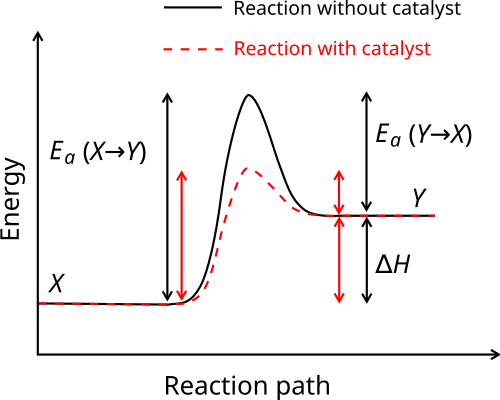
Energy profile diagram: the activation energy (Ea) is the minimum energy needed for a reaction to occur. A catalyst lowers Ea, allowing more collisions to succeed without changing the overall energy change (ΔH).
Common Mistake: Catalyst definition
A catalyst increases the rate of reaction by providing a lower energy pathway. It is NOT 'used up' in the reaction. Do not say it 'makes particles collide more' — it lowers activation energy. Also: a catalyst does NOT change the energy released (ΔH) — only the minimum energy required to start the reaction.
6. Organic Chemistry
Organic chemistry is the chemistry of carbon compounds. Crude oil is a mixture of hydrocarbons (compounds of hydrogen and carbon only) separated by fractional distillation. The alkane homologous series has general formula CₙH₂ₙ₊₂ — single bonds only, saturated. The alkene series has formula CₙH₂ₙ — contains a C=C double bond, unsaturated. Alkenes decolourise bromine water (orange → colourless) — this is the test for unsaturation. Combustion of hydrocarbons: complete combustion → CO₂ + H₂O; incomplete (limited O₂) → CO + H₂O + soot (carbon). Polymers: addition polymerisation of alkene monomers (e.g. ethene → poly(ethene) / polyethylene). Condensation polymerisation forms polyesters and polyamides (nylon) with loss of small molecules.
Key organic reactions to know
- Combustion: alkane + O₂ → CO₂ + H₂O (complete) — used as fuels
- Addition of H₂ (hydrogenation): alkene + H₂ → alkane (Ni catalyst, 150°C) — makes margarine from vegetable oils
- Addition of Br₂: alkene + Br₂ → dibromoalkane (decolourises brown bromine water — test for C=C)
- Addition of H₂O (hydration): alkene + H₂O → alcohol (H₃PO₄ catalyst, 300°C) — industrial ethanol
- Fermentation: glucose → ethanol + CO₂ (yeast, 37°C, anaerobic) — alcoholic drinks
- Oxidation of ethanol: ethanol + O₂ → ethanoic acid (vinegar) — wine turning sour
- Esterification: alcohol + carboxylic acid → ester + water (acid catalyst) — makes fragrances
7. Electrolysis
Electrolysis is the decomposition of an ionic compound using electricity. It requires an electrolyte (molten or dissolved ionic compound) and two electrodes (cathode = negative, anode = positive). At the cathode: positive ions (cations) gain electrons and are reduced — metals or hydrogen are deposited. At the anode: negative ions (anions) lose electrons and are oxidised — non-metals are released. Mnemonic: OILRIG (Oxidation Is Loss, Reduction Is Gain). When aqueous solutions are electrolysed, water competes: if the metal ion is below hydrogen in the reactivity series, the metal is deposited; otherwise H₂ is produced. At the anode: Cl⁻, Br⁻, I⁻ ions are discharged (halogen gas released); otherwise O₂ is produced from water. Electrolysis is used industrially to extract aluminium from molten aluminium oxide (bauxite), electroplate metals, and purify copper.
Exam Tip: Half equations at electrodes
Always balance half equations by: (1) balancing atoms, (2) adding electrons (e⁻) to balance charge. Cathode (reduction): Cu²⁺ + 2e⁻ → Cu. Anode (oxidation): 2Cl⁻ → Cl₂ + 2e⁻. Remember that at the ANODE, electrons are LOST (OIL) and at the CATHODE, electrons are GAINED (RIG).
Ready to test your knowledge?
Take a quick quiz on Chemistry to reinforce what you've just read.